Thursday, July 14, 2011

Stress Echocardiography Predictive of Heart Attack or Death in HIV Patients


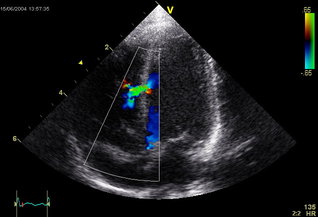
Abnormal results on a stress echo-
cardiogram in HIV patients with
known or suspected heart disease
 predict dramatically higher risk of
heart attack or cardiac death.
(Image courtesy: Wikipedia, taken by
Kjetil Lenes)
HIV patients with abnormal results on a ultrasound stress test have nearly a 10 times higher risk of a heart attack or cardiac death than the normal population, and more than three times the risk of people without HIV who have an abnormal stress echocardiogram a new study shows.

Senior author of the study, 
Dr. Farooq Chaudhry, associate professor of medicine, and colleagues at Columbia University College of Physicians and Surgeons in New York City performed stress echo tests on 311 HIV patients with suspected or known heart disease. They reported their findings online before the July 12, 2011 print issue of Circulation: Cardiovascular Imaging.
The researchers looked at whether stress echo can help predict risk of heart attack and death in a high-risk population, in this case HIV patients with known or suspected heart disease. HIV infection and the drugs used to treat it have been associated with accelerated coronary artery disease and cardiovascular events in prior research. While stress echocardiography is an accepted method of diagnosis, risk evaluation and prognosis of coronary artery disease, its prognostic value in HIV-positive patients is unknown. (Link to published site)

Stress Echocardiography Predictive of Heart Attack or Death in HIV Patients

Abnormal results on a stress echocardiogram in
HIV patients with known or suspected heart
 disease predict dramatically higher risk of
heart attack or cardiac death.
(Image courtesy: Wikipedia, taken by Kjetil Lenes)

HIV patients with abnormal results on a ultrasound stress test have nearly a 10 times higher risk of a heart attack or cardiac death than the normal population, and more than three times the risk of people without HIV who have an abnormal stress echocardiogram a new study shows.

Senior author of the study, Dr. Farooq Chaudhry, associate professor of medicine, and colleagues at Columbia University College of Physicians and Surgeons in New York City performed stress echo tests on 311 HIV patients with suspected or known heart disease. They reported their findings online before the July 12, 2011 print issue of Circulation: Cardiovascular Imaging. (Link to published site)

Tuesday, July 12, 2011

Weekly Byetta clears heart rate hurdle

July 12th, 2011 by Ryan Luce No Comments
written by Michael O'Leary

Good news for people who have had good results controlling the HbA1c with BYETTA®. The Associated Press, Reuters report that new study results of the once-a-week formulation of the drug show that the drug does not affect heart rate.

Last October, the FDA declined approval of the once-a-week BYDUREON™ for type 2 diabetes and requested that the drug’s maker, Amylin Pharmaceuticals, provide more information about the drug’s effect on patients’ heart rates. (Link to published site)

Friday, July 8, 2011

Hitting targets reduced deaths and heart problems – but not by much

by Michael O’Leary
Early, intensive treatment of type-2 diabetes that targets multiple health factors such as high blood pressure and cholesterol reduced the number of people who had heart attacks and died but the difference was not large enough to be convincing, researchers say.

The ADDITION study is a collaboration of doctors in the United Kingdom, the Netherlands and Denmark. It started with screening for type-2 diabetes followed by a treatment phase comparing the results of usual treatment for the disease to that of rigorously treating patients in order to achieve strict targets for blood sugar, blood pressure and cholesterol levels. (Link to published site)

First use of Metal Nanoparticles IDs Liver Cancer on X-ray

PROVIDENCE – July 8, 2011 – Using metal nanoparticles for the first time as an imaging agent researchers have developed a new technique to detect heptocellular carcinoma at a much earlier, treatable stage than is currently available, a new study suggests.

A new diagnostic technique can spot tumor-like masses as small as 5 millimeters in the liver. Gold nanoparticles with a polyelectrolyte coating can make smaller tumors more visiblethrough X-ray scatter imaging, enabling earlier diagnosis. (credit: Rose-Petruck Lab/Brown University)
Heptocellular carcinoma is the most common cancer of the liver striking more than half a million people worldwide each year. It is especially prevalent in sub-Saharan Africa and Southeast Asia. Because it is usually diagnosed only when tumors have grown to about 5 centimeters in size, most of those afflicted die within six months.  (Link to published site)

Thursday, June 30, 2011

Screening With CT Scans Reduces Lung Cancer Deaths

The National Lung Screening Trial showed
that a regularscreening program using CT
scans can reduce lung cancerdeaths by as
much as 20 percent. (Photo courtesy National
Cancer Institute. Daniel Sone, photographer)


BETHESDA – June 30, 2011 – For the first time, a screening program for lung cancer has produced a reduction in lung cancer deaths. The US National Lung Screening Trial (NLST) published data today showing that routine low-dose CT scans in heavy smokers reduced deaths by 20 percent compared to conventional x-rays. Questions of cost-effectiveness and healthcare utilization, however, remain to be answered.

The NLST had announced the initial results of the $250 million trial last fall showing that low-dose CT scans reduced lung-cancer and deaths from any cause overall compared to x-ray screening. The full report appears today in the New England Journal of Medicine but it won’t be the final report as the researchers will be undertaking further analyses to determine if the substantially higher costs of CT scans are worth it. (Link to published site)

Screening With CT Scans Reduces Lung Cancer Deaths


The National Lung Screening Trial showed that a regular
screening program using CT scans can reduce lung
cancer deaths by as much as 20 percent. (Photo
courtesy National Cancer Institute. Daniel Sone,
photographer)
For the first time, a screening program for lung cancer has produced a reduction in lung cancer deaths. The US National Lung Screening Trial (NLST) published data today showing that routine low-dose CT scans in heavy smokers reduced deaths by 20 percent compared to conventional x-rays. Questions of cost-effectiveness and healthcare utilization, however, remain to be answered. (Link to published site)